RotLight: Rotated Lights for
Consistent and Efficient 2D
Gaussians Inverse Rendering
Abstract
Inverse rendering aims to decompose a scene into its geometry, material properties and light conditions under a certain rendering model. It has wide applications like view synthesis, relighting, and scene editing. In recent years, inverse rendering methods have been inspired by view synthesis approaches like neural radiance fields and Gaussian splatting, which are capable of efficiently decomposing a scene into its geometry and radiance. They then further estimate the material and lighting that lead to the observed scene radiance. However, the latter step is highly ambiguous and prior works suffer from inaccurate color and baked shadows in their albedo estimation albeit their regularization. To this end, we propose RotLight, a simple capturing setup, to address the ambiguity. Compared to a usual capture, RotLight only requires the object to be rotated several times during the process. We show that as few as two rotations is effective in reducing artifacts. To further improve 2DGS-based inverse rendering, we additionally introduce a proxy mesh that not only allows accurate incident light tracing, but also enables a residual constraint and improves global illumination handling. We demonstrate with both synthetic and real world datasets that our method achieves superior albedo estimation while keeping efficient computation.
Overview
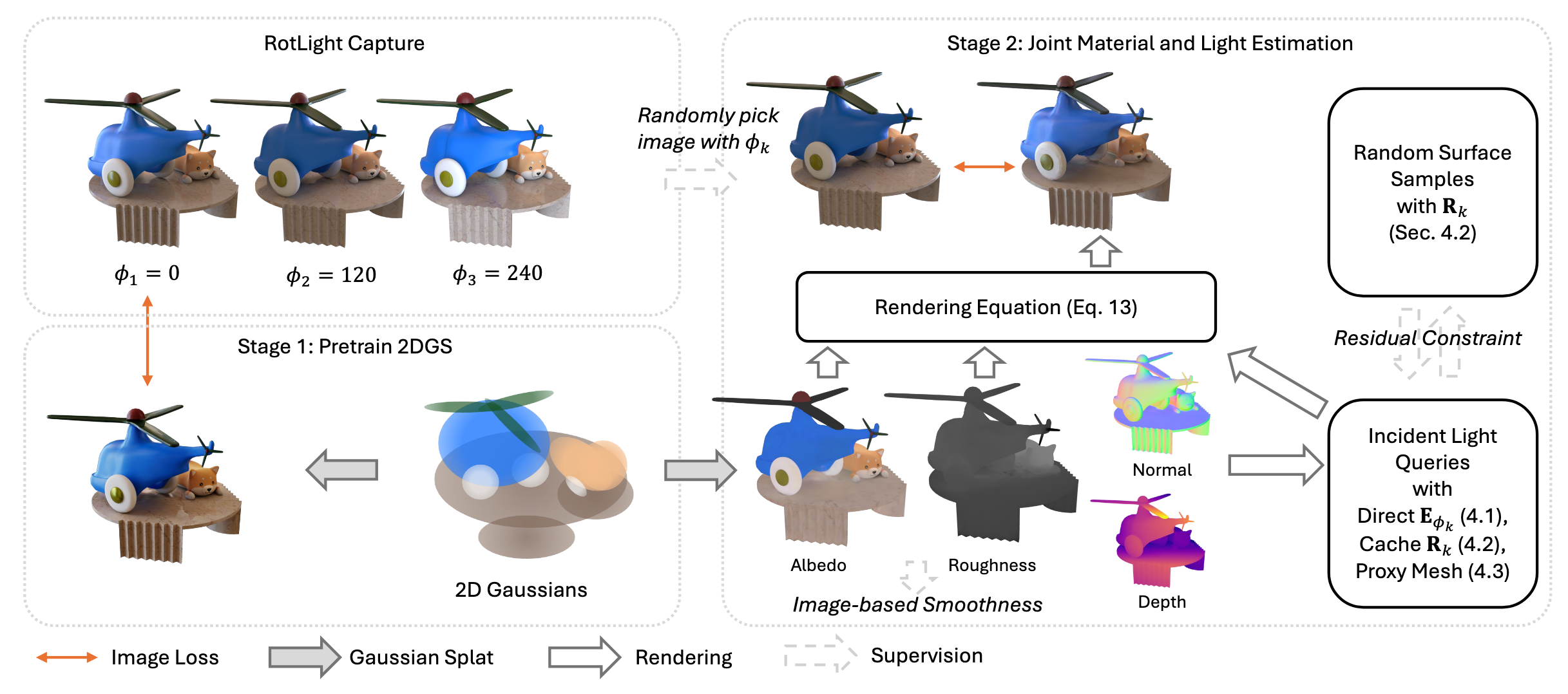
Overview of our pipeline. RotLight: we capture the same object with K=3 different rotations. Stage 1: we pretrain a 2DGS model with a set of images under the same lights to obtain an initial geometry reconstruction of the scene. Stage 2: we obtain pixel material, depth and surface normal by splatting Gaussians. The depth and normal are used to query incident lights, with direct illumination from the environment map (Section 4.1), and indirect illumination from a radiance cache (Section 4.2). The radiance cache is further supervised with a residual constraint evaluated at random surface points. For accurate incident sampling, we also use a proxy mesh instead of ray tracing the Gaussians (Section 4.3).
BibTeX
@article{Lin2026RotLight,
  title={Rotated Lights for Consistent and Efficient 2D Gaussians Inverse Rendering},
  author={Geng Lin and Matthias Zwicker},
  journal={arXiv preprint arXiv:2602.08724},
  year={2026},
  url={https://arxiv.org/abs/2602.08724}
}